How to adjust cabinet hinges: sideways, depth and height
Almost every concealed cup hinge can be adjusted in three directions with a cross-head screwdriver, without taking the door off. This guide shows which screw does what, how far each one goes, and how to fix the usual problems: a sagging door, uneven gaps, a door that sticks out, or a soft-close door that will not shut.
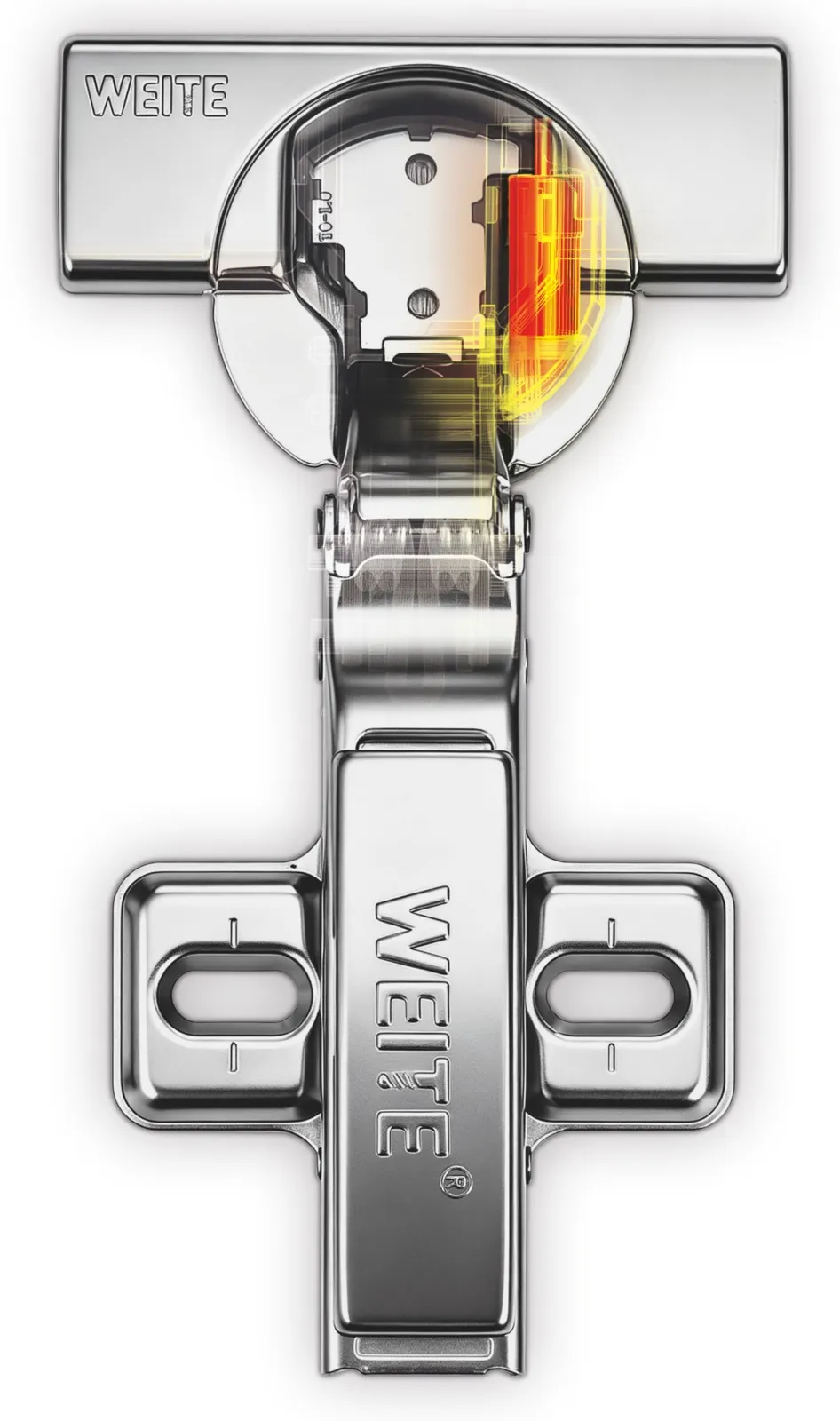
Short answer
- Door too far left or right, or gaps uneven: the side screw on the arm, nearest the door.
- Door sticks out or sits too deep: the depth screw at the back of the arm.
- Door too high or too low: the mounting plate on the cabinet side.
- Typical range on WEITE soft-close hinges: ±2 mm sideways, ±2 mm height, ±4 mm depth.
In this guide
The three adjustments
A concealed hinge, also called a cup hinge or European hinge, has three parts: a round cup set into a 35 mm hole in the back of the door, an arm, and a mounting plate screwed to the cabinet side. Each adjustment moves the door along one axis. Turn a screw a quarter-turn at a time and close the door to check; the direction that tightens or widens a gap is not the same on every hinge, so watch the door rather than counting turns.
1. Sideways (overlay) adjustment
The screw on the arm closest to the door moves the door left or right. Use it to even out the gap between two doors, to stop a door rubbing its neighbour, or to straighten a door that leans. Because you can turn the top and bottom hinge by different amounts, this is also the screw that fixes a door that hangs at an angle.
2. Depth adjustment
The screw at the back of the arm moves the door towards or away from the front edge of the cabinet. Use it when one corner of the door stands proud of the carcass, or when the door touches the cabinet edge before it is fully closed. On some hinges this is an eccentric cam you turn; on others you loosen the screw, slide the arm in its slot and tighten it again.
3. Height adjustment
Height is set at the mounting plate. On plates with slotted holes, loosen the plate screws, move the door up or down and tighten them again. On 3D plates a cam does the same job without loosening anything. Move every hinge on the door by the same amount, or the door will twist.
| WEITE model | Sideways | Height | Depth | Mounting |
|---|---|---|---|---|
| 6913, 6914, 6921 | ±2 mm | ±2 mm | ±4 mm | Fixed, screw-on arm |
| 6928 | ±4 mm | ±2 mm | ±3 mm | Clip-on |
| 6931 | Worm-gear, multi-axis | ±3 mm | ±3 mm | Clip-on, tool-free |
| 6915 (doors to 36 mm) | ±2 mm | ±2 mm | ±3 mm | Clip-on |
Every model page lists its own ranges in the specification table. If a door needs more than the range allows, the hinge holes or the plate position are off; see when adjusting is not enough.
The right order
- Check the screws first. Tighten the plate screws and the screws that hold the cup in the door. A loose plate makes every other adjustment drift.
- Sideways first. Get the gaps between doors even and the door edges vertical.
- Then depth. Bring the door flush with the cabinet front and with its neighbours.
- Height last. Line up the top edges across a run of doors.
- Test the closing. Open the door fully and let it go from several angles. A soft-close door should slow down in the last few degrees and shut without a bang.
Common problems and fixes
| What you see | Likely cause | Fix |
|---|---|---|
| Door sags: the corner away from the hinges is lower | Door has rotated on its hinges | On the top hinge, move the door away from the hinge side with the sideways screw, or on the bottom hinge move it towards the hinge side. |
| Gap between two doors is wider at the top than the bottom | One door leans | Same as above, on the door that leans. Small corrections on both doors give the straightest line. |
| Top or bottom corner sticks out | Depth differs between the two hinges | Depth screw on the hinge at the corner that sticks out. |
| Door rubs the next door or the cabinet edge | Too far sideways, or too little depth | Sideways screw first; if it still touches, add a little depth. |
| Soft-close door stays slightly open | Door touches something before the damper finishes, or the hinge spring is too weak for the door | Check depth and sideways so nothing rubs; check that drawers or pull-outs inside do not hit the door; on tall or heavy doors add a hinge. |
| Door slams although the hinge is soft-close | Damper not engaged, or too few dampers for the door weight | On hinges with a detachable damper, such as the 6921, check that the damper is clipped onto the arm. Heavy doors need more hinges. |
| Small door closes very slowly | Too much damping for a light door | Where the damper is detachable, remove it from one hinge so only one hinge damps. |
| Door hits a wall or the next door when opened | Opening angle too wide for the space | Use a 90° hinge such as the 6923, which stops the door before it reaches the obstacle. |
How many hinges a door needs
Door height and weight decide the number of hinges. A widely used rule of thumb for 16 to 19 mm wooden doors is below. Wider, thicker, glass or mirror doors are heavier and need one hinge more. When in doubt, add a hinge: it costs little and stops the door sagging over the years.
| Door height | Hinges |
|---|---|
| Up to 900 mm | 2 |
| 900 to 1600 mm | 3 |
| 1600 to 2000 mm | 4 |
| 2000 to 2400 mm | 5 |
When adjusting is not enough
- Wrong overlay type. Full overlay (straight arm, WEITE suffix 0309) covers the whole side panel; half overlay (0308) covers half so two doors can share one partition; inset (0307) puts the door inside the cabinet. A hinge of the wrong type cannot be adjusted into the right position.
- Cup hole in the wrong place. If the 35 mm hole was drilled too close to or too far from the door edge, the door will sit outside the adjustment range. Check the drilling distance on the drawing on each model page before drilling a run of doors.
- Door thicker than the hinge allows. Many WEITE soft-close hinges take 16 to 28 mm doors; the 6915 takes doors up to 36 mm.
- Screws pulling out of particleboard. Move the plate a few millimetres to fresh material or use the correct euro screws for the plate.
Clip-on hinges such as the 6931 and 6928 let you take a door off and put it back without losing the adjustment, which helps when doors are painted or transported separately.
Questions buyers ask
Which screw on a cabinet hinge moves the door left and right?
The screw on the arm closest to the door. Turn it a quarter-turn at a time and close the door to check the gap.
How much can a concealed hinge be adjusted?
Most WEITE soft-close hinges adjust ±2 mm sideways, ±2 mm in height and ±4 mm in depth. The 6928 adjusts ±4 mm sideways; the 6931 ±3 mm in height and depth. Each model page lists its ranges.
Why will my soft-close cabinet door not close fully?
Usually the door touches the cabinet edge, a neighbouring door or something inside before the damper finishes. Correct the sideways and depth adjustment first; on tall or heavy doors add a hinge.
Do I need to take the door off to adjust the hinges?
No. All three adjustments are made with the door hanging. Clip-on hinges can also be removed and refitted without losing the setting.
How many hinges does a 2 m wardrobe door need?
As a rule of thumb, four hinges for doors from 1600 to 2000 mm high, and one more if the door is wide, thick or has glass or a mirror.
Stocking cabinet hinges?
WEITE makes 27 hinge models in Foshan, tested to 50,000 open-close cycles in our own CNAS testing centre. Free samples of standard models for distributors.